

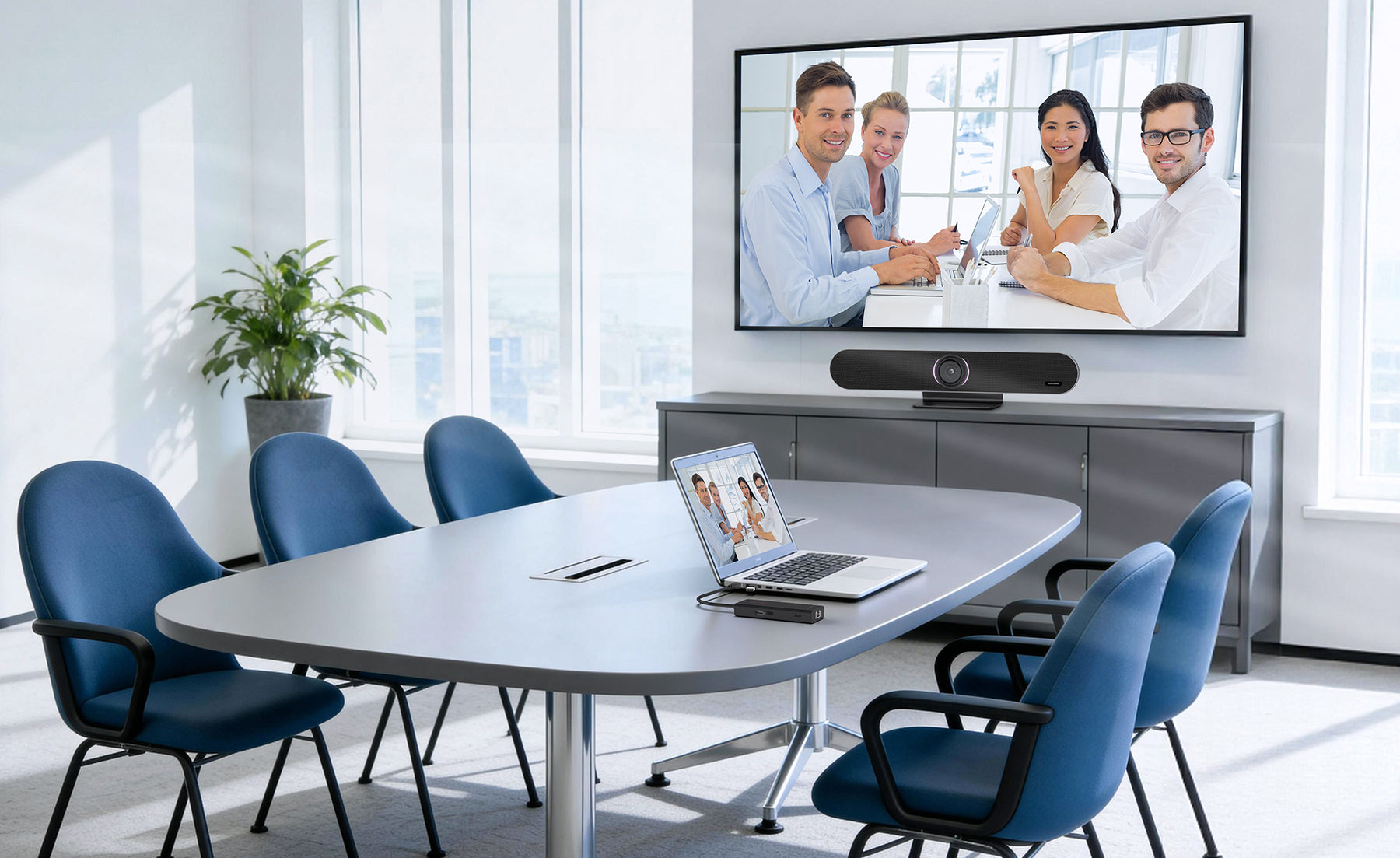
Picture this: Three teammates huddle around a conference table, cracking jokes. On screen, remote colleagues sit muted—not because they have nothing to say, but because the microphone only picks up the table group. The whiteboard? A blurry patch no one online can read.
Hybrid meetings weren’t supposed to feel this broken.
The issue isn’t the concept of hybrid work—it’s the execution.
Too often, meeting spaces are built around assumptions rather than real user needs. The result? A disconnect between in-room and remote participants that undermines productivity and collaboration.
Here are five of the most common gaps in hybrid meetings—and what solves them.
1. The “In-Room Advantage” Problem
The gap:
In-person attendees dominate the conversation, while remote participants struggle to jump in or even feel included.
Why it happens:
When Audio Fails, Everything Else Follows
Cameras don’t capture everyone clearly, and audio pickup is inconsistent. Remote participants are essentially “observers,” not contributors.
What actually solves it:
A setup that prioritizes equity of presence:
-
Wide-angle or multi-camera coverage so everyone is visible
-
Intelligent framing that highlights active speakers
-
Clear, balanced audio across the room
When remote participants can see faces and hear clearly, they’re far more likely to engage.
2. When Audio Fails, Everything Else Follows
The phrase “Can you repeat that?” has become the unofficial meeting soundtrack. Built-in laptop mics and bare-bones audio systems simply can’t handle the real world—distance, background noise, and overlapping voices.
The fix isn’t just “better microphones.” It’s a dedicated audio system with even, full-room pickup, noise reduction, and echo cancellation that makes every seat a front-row seat. Because if people can’t hear clearly, no amount of crisp video will save the meeting.
3. Technology That’s Too Complicated
The gap:
Meetings start late because someone is troubleshooting connections, cables, or software.
Why it happens:
Overly complex setups create friction for both employees and IT teams.
What actually solves it:
Simplicity and standardization:
-
Simple, plug-and-play setups that boot up before your coffee gets cold.
-
Uniform equipment across rooms—no adapters, no “which cable goes where,” no downtime.
-
Native compatibility with Zoom, Teams, and other platforms, so it always feels native.
When the tech disappears, the meeting can actually happen.
4. Inconsistent Experiences Across Rooms
The gap:
Every meeting room feels different—some work perfectly, others don’t.
Why it happens:
Ad hoc setups and mixed hardware create unpredictable experiences.
What actually solves it:
A standardized approach to deployment:
-
Unified hardware and configurations
-
Scalable solutions that work across room sizes
-
Easier management and fewer support issues
Consistency builds confidence—for both users and IT teams.
5. Solutions That Don’t Scale
The gap:
What works in one room doesn’t translate across the organization.
Why it happens:
Solutions are chosen for short-term needs rather than long-term growth.
What actually solves it:
Think beyond a single room:
-
Modular, flexible systems
-
Solutions designed for multi-room deployment
-
Reliable performance across different environments
Scalability isn’t just about growth—it’s about sustainability.
Closing Thoughts
Hybrid meetings aren’t going away—but the frustration around them doesn’t have to stay.
Organizations that focus on clarity, simplicity, and consistency are the ones turning hybrid meetings into a true advantage, not a daily challenge.
The best hybrid meetings don’t feel like hybrid. They just feel like meetings—clear voices, visible faces, shared ideas. If your organization is ready to move past frustration and into flow, Rocware can help you build spaces where every seat is a good seat.
Share:
Are Cameras Replacing Conference Room Etiquette?
The Real ROI of Simplified AV Deployments